 Download Brochure
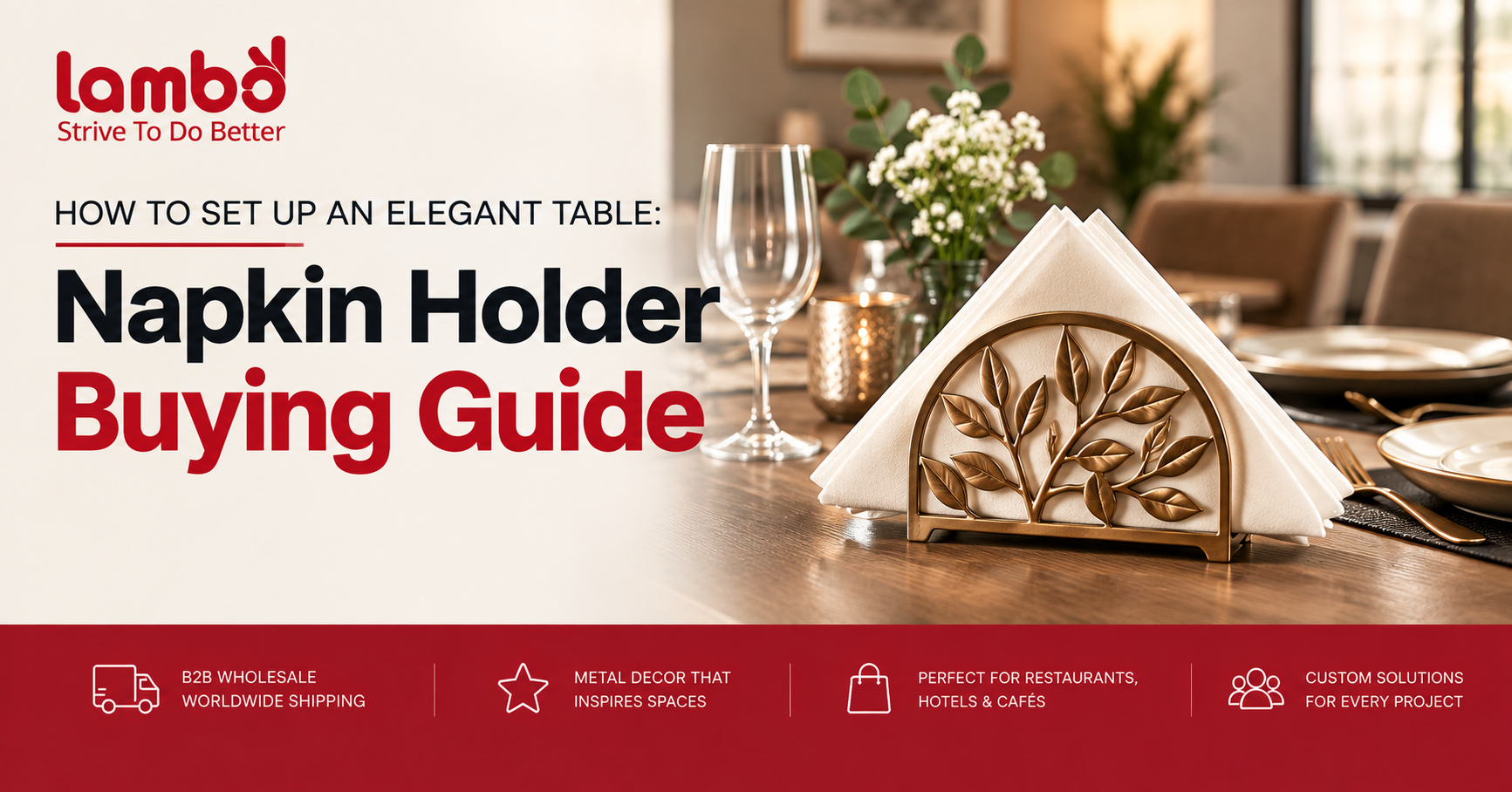
 How to Set Up an Elegant Table: Napkin Holder Buying Guide
The Napkin Holder Buying Guide: Choosing the Right One for Home and Restaurant Tables
There is a particular frustration that comes from setting a genuinely good table—good plates, good linen, considered cutlery—and then placing a plastic napkin holder in the middle of it. Everything that took thought suddenly looks like it did not.
The metal napkin holder for the dining table is the most handled object on a set table. Every guest touches it. It sits at the center of the setting, in everyone’s sightline from the moment they sit down. For a home entertainer, it signals whether the table was put together with care.
For a restaurant or cafe owner, a poor choice here communicates something about the space that even exceptional food cannot fully correct. This guide covers the decisions that matter: material, style, sizing, and what changes when you are buying for a single home table versus outfitting an entire restaurant floor.
A metal napkin holder with a powder-coated finish is the benchmark for durability in both home and commercial settings. It does not absorb moisture, so it will not warp or swell in humid dining environments. The powder coat prevents rust under daily use and standard cleaning.
The weight of cast iron designs means the holder stays in place rather than shifting each time a napkin is pulled out. For any table set every day, metal is the only material that delivers durability and aesthetics without a maintenance trade-off.
Wood looks excellent in product photography. In practice, it absorbs moisture from hands and the dining environment, warps at the slot edges over time, and shows wear at contact points quickly — especially in commercial settings where ‘over time’ can mean weeks rather than months. Fine for occasional formal use at home, but the wrong material for daily service.
Brass brings warmth and formality that no other material quite replicates. The constraint is tarnishing—the oils from fingertips dull the surface within weeks of regular handling, and maintaining its appearance requires consistent polishing. Manageable for occasional home use; impractical for a restaurant floor with daily service across 30 tables.
Inexpensive and easy to sanitize, which is why it appears in fast-food settings where replacement cost is the only consideration. In any setting where the table experience is part of the product, plastic reads as a placeholder, not a decision.
Style selection works best when the holder is treated as part of the table’s overall visual language, not a standalone piece. Decorative napkin holder settings fall into three categories.
Modern and minimalist tables call for open-frame geometric designs in matte black or brushed metal—clean lines, no ornamentation. Traditional and formal tables suit ornate ironwork or scroll forms in warm tones like antique bronze or warm iron.
Character-driven settings—rustic, coastal, and eclectic—have the most flexibility; botanical motifs and artisan ironwork work well here. In all three cases, the rule is coherent with the broader table, not just matching a single element.
👉 Explore Our Diverse Range of Metal Napkin Holders
For home dining tables, proportion is the main consideration. A holder should not dominate the centerpiece arrangement—roughly one-fifth of the table width works as a starting guide for a standard four-to-six-seat table. Slot width matters too: a holder built for paper napkins will grip a linen napkin awkwardly. Match the slot format to the napkin type you actually use.
For restaurant napkin holder bulk orders, footprint becomes the priority. A typical two-person cafe table is 60 to 70 centimeters across, and a holder that feels appropriate on a home dining table can make a small restaurant table feel cluttered. Compact upright designs in a consistent finish work best. For paper service, a tight-slot upright keeps napkins clean and reduces waste during busy turns. For cloth napkins, an open-frame design is the correct choice — a tight slot will crush the fold and make it look disheveled within minutes of service starting.
For commercial buyers, reorder consistency is worth planning from the outset. Ordering manufacturer-direct from LamboArts means every unit in a batch comes from the same production run—same finish, same base weight, same slot dimensions—so there are no visible mismatches across a full floor of tables.
A napkin holder sits alongside cutlery, condiment holders, candles, and seasonal centerpiece elements. The most reliable approach is to match the holder finish to the cutlery tone rather than to the linen or crockery. Matte black holder with dark-handled cutlery is cohesive and strong. Warm iron with bronze- or gold-toned cutlery reads as deliberate.
One practical advantage of a quality metal holder is seasonal versatility—it works alongside Christmas settings, summer entertaining schemes, and everyday meals without ever looking wrong.
A metal napkin holder with a matte black finish, in particular, spans almost every table direction without needing to be swapped out. Choose for the full year, not the occasion you are currently dressing for.
A quality napkin holder for dining table use — one that holds its finish, weight, and form over years of daily service — is not an expensive decision. It is considered one. And a table that has been considered all the way down to this detail looks like it has been. Get in touch with LamboArts to explore our exclusive napkin holder collection or submit a wholesale inquiry for bulk pricing.
What is the best napkin holder material for restaurant and cafe tables?
Powder-coated iron or cast iron. It is wipe-clean, rust-resistant, and consistent across reorders—the three things that matter most in a commercial setting. Matte black is the most practical finish for commercial use because it reads well across different dining environments and does not show handling marks under dining room lighting.
Can I order napkin holders in bulk with a matching finish for all my tables?
Yes. LamboArts manufactures metal home decor, including napkin holders, for wholesale and bulk commercial orders. All units in a batch are produced from the same run, ensuring consistent finish and dimensions across your full table inventory. Submit an RFQ for a custom quote and confirmed lead time.
What is the difference between a paper napkin holder and a cloth napkin holder?
Slot width and design. Paper holders use a tight, narrow slot that keeps folded paper napkins upright and clean. Cloth napkin holders use a wider slot or open-frame design that accommodates the volume and weight of a folded cloth napkin without crushing the fabric. Using a paper holder for cloth napkins will look wrong at every service.
Phone: +1 833 655 2626
Email: mkt.usa@lamboarts.com
Address: Houston - Texas, USA
Phone: +91 81550 11461
Email: mkt.in@lamboarts.com
Address: Ahmedabad, India