 Download Brochure
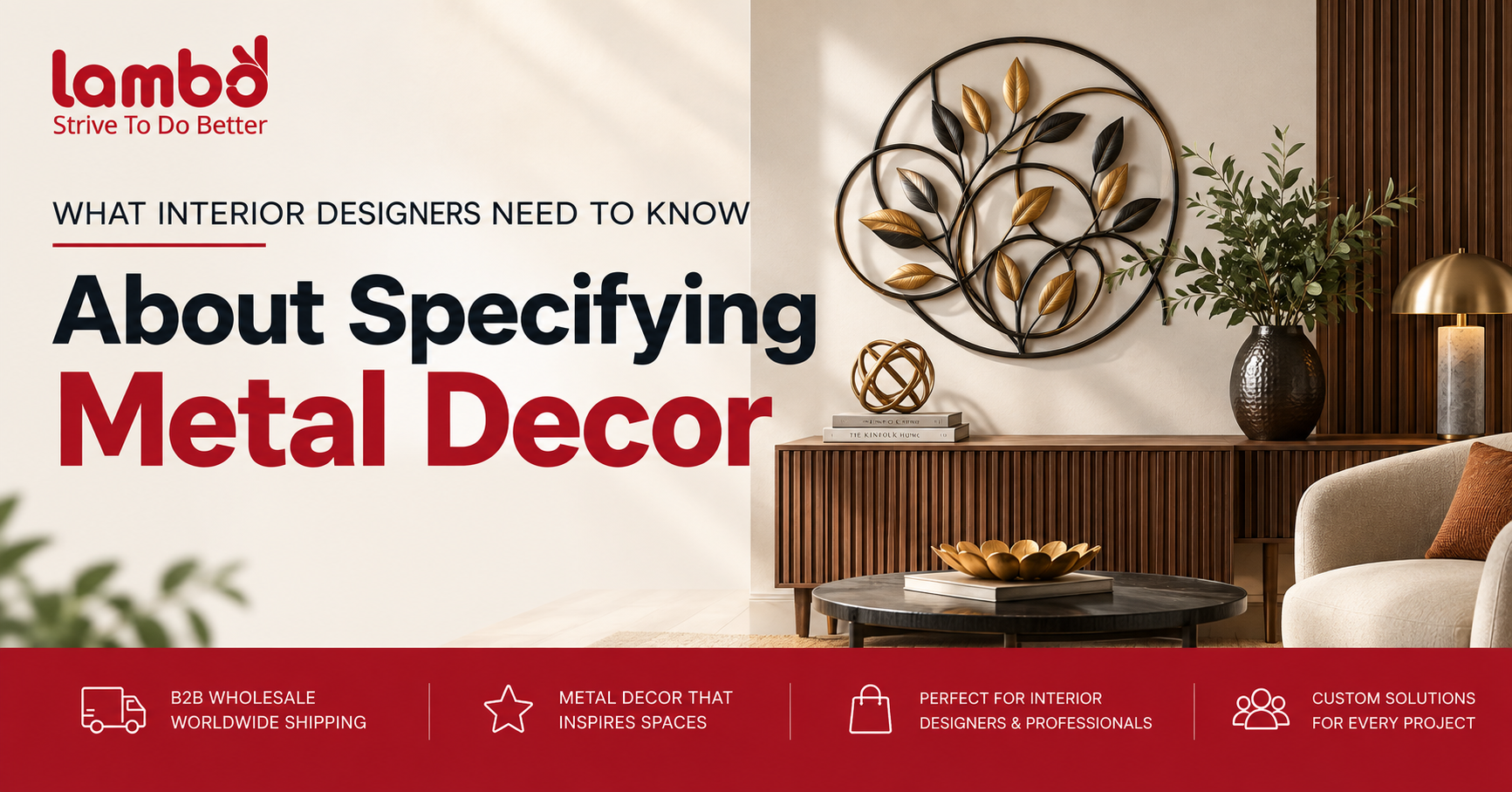
 What Interior Designers Need to Know About Specifying Metal Decor
Interior Designer’s Guide to Specifying Metal Decor: Finishes, Scale, and Trade Sourcing
Client briefs have changed. Where designers were once interpreting vague requests for ‘interesting wall art,’ they are now fielding specific asks—references organized by finish and requests for ‘hand-forged,’ ‘matte black,’ and ‘dimensional.’ Metal wall decor is no longer a niche specification. It is a mainstream expectation across residential and commercial projects, and the clients asking for it have usually done their own research. What they need from a designer is the expertise to translate a reference image into a specification that will actually work in the space.
This guide covers the decisions that matter in practice: finish selection, scale rules for residential versus commercial contexts, where metal works and where it requires qualification, and how to source ready-made pieces at trade pricing without compromising on design integrity.
A final decision made before understanding the palette, the lighting, and the client’s reference points creates rework. This metal wall decor guide for interior design covers the four finishes that come up most in current briefs.
The most versatile finish available right now. Matte black works across modern, industrial, transitional, and Scandi interiors without competing with warm or cool palettes. For commercial specifications, it is the lowest-risk choice — it photographs well, handles contact without showing marks, and does not require the client to commit to a specific color direction before the rest of the scheme is resolved.
Earthy and tactile in a way matte black is not. Warm iron belongs in Japandi interiors, organic-modern settings, and spaces built around natural materials—linen, rattan, reclaimed timber, and unglazed ceramic. It interacts with warm ambient lighting, picking up the glow of Edison bulbs and candlelight. It does not work in cool-grey or blue-toned palettes, where it reads as misaligned rather than contrasting.
Brass suits traditional and maximalist schemes where richness is the brief. The specification constraint—particularly for commercial projects—is maintenance. Brass tarnishes with daily handling and requires regular polishing. For residential clients using pieces as occasional decorative objects, this is manageable. For a hotel or restaurant with daily guest contact across dozens of touch points, it is a specification risk that needs to be flagged before the piece is committed to.
The defining direction of 2025 to 2026 is the one most likely to go wrong without a clear hierarchy. One finish dominates, and one acts as an accent—never in equal proportion. Matte black as primary with warm iron or brass as an accent is the most reliable current combination. Equal distribution reads as indecision. When a client brings a mixed-metals brief, establishing the hierarchy is the first design task, before any sourcing begins.
Also Read: The Complete Guide to Metal Wall Art for Hotels and Commercial Spaces
Scale mistakes in commercial specifications almost always come from applying residential rules to a different physical environment. Specifying metal wall art for commercial interiors means accounting for ceiling heights, viewing distances, and room proportions that have no residential equivalent.
A piece that reads as generous at 8 feet of viewing distance reads as tentative at 25 feet. In hotel lobbies and commercial dining rooms, start significantly larger than instinct suggests and move center height to 62 to 65 inches.
Dimensional metal pieces—sculptural work with genuine depth—have a decisive advantage at commercial scale because they create shadow play and light variation that flat art cannot, and they photograph differently from every angle, which matters for properties investing in visual marketing.
In hotel corridors, the logic inverts. Series pieces at consistent intervals create rhythm and guide movement through the space more effectively than isolated statement pieces. The individual pieces do not need to carry statement weight—the series does.
Part of a confident specification is knowing where to apply a caveat. Metal decor for residential projects works without qualification in living rooms, hallways, home offices, dining rooms, and bedrooms where the motif suits the space. Botanical and organic metal forms are moving into mainstream residential briefs through biophilic design interest—they provide natural warmth without requiring literal plants or organic materials.
In kitchens, specify powder coat only—it seals the surface against steam and moisture where raw or painted finishes will eventually fail. In bathrooms, keep metal art on dry feature walls, away from direct spray zones. For coastal properties, confirm powder coat explicitly—salt air will degrade raw or painted finishes over time, regardless of the indoor placement.
Where metal does not belong: ornate traditional rooms where wrought iron reads as heavy rather than decorative, children’s bedrooms where weight and edges are practical concerns, and very small rooms where the visual density of a metal piece feels oppressive rather than anchoring.
The sourcing conversation catches designers at the worst moment—after the client has approved the art selection and the supplier reality arrives. For wholesale metal decor, three things need to be confirmed before any piece appears in a design document: MOQ, lead time, and finish consistency across the batch.
MOQ first. Discovering the minimum order quantity after client approval creates friction that is difficult to recover from. At LamboArts, MOQ is confirmed during the RFQ process — get that information before the presentation, not after.
Lead time, second. Standard designs require one to two months from order confirmation to delivery. For projects with hard installation dates—hotel openings, residential handovers, and pre-opening press access—that window must be in the schedule from the start. It cannot be inserted after the timeline is already compressed.
Finish consistency third. Marketplace sourcing aggregates across production runs and cannot guarantee batch-level consistency. Manufacturer-direct ordering from LamboArts produces all units from the same run, which is the only way to guarantee that every piece in a 40 or 80-unit commercial order matches.
The metal decor trend of 2026 is settled—matte black has become a neutral, not a trend. Specifying it now does not require justification. Three-dimensional sculptural metal pieces are gaining the most ground in commercial briefs; hotel procurement teams recognize that dimensional work creates visual complexity and photographs better than flat art, making it the stronger specification for high-visibility feature walls.
Nature-inspired forms—botanical motifs, organic shapes in powder-coated metal—are entering mainstream residential briefs through biophilic design interest and are among the easiest residential specifications to present and defend.
The client who arrives with a matte black metal wall art reference needs a designer who can translate that reference into a specification that works—finish, scale, application, sourcing method, and lead time. The decisions in this guide are the ones that separate a confident specification from an uncertain one. Contact us for metal decor for interior designers or submit an RFQ for trade and wholesale pricing and sourcing support.
What is the difference between powder-coated and painted metal finishes?
Powder coating is an electrostatic process that bonds the coating to the metal at a molecular level, producing a finish significantly harder and more chip-resistant than spray paint. Powder-coated metal decor durability is why it is the standard for commercial applications. If a supplier cannot confirm the finish is powder-coated, treat it as a specification risk.
Do you offer trade pricing and samples for interior designers?
Yes. LamboArts offers trade pricing for designers ordering at volume and accommodates sample orders before full batch commitments. Inquiries are handled through the RFQ form. Designers working across multiple projects can discuss ongoing trade arrangements through the same channel.
Phone: +1 833 655 2626
Email: mkt.usa@lamboarts.com
Address: Houston - Texas, USA
Phone: +91 81550 11461
Email: mkt.in@lamboarts.com
Address: Ahmedabad, India