 Download Brochure
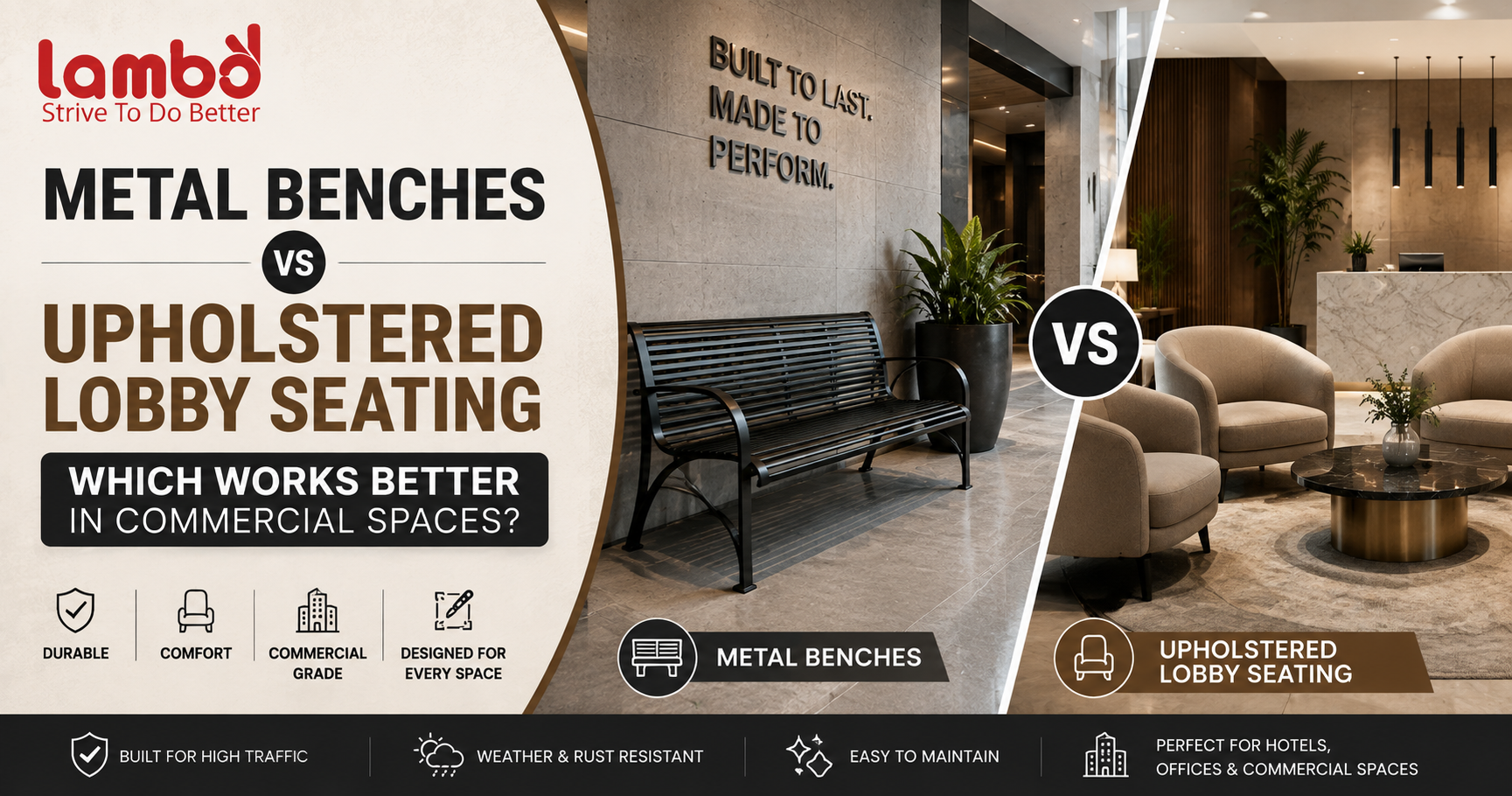
 Metal Benches vs Upholstered Lobby Seating: Which Works Better in Commercial Spaces?
Go stand in a hotel lobby that was fitted out around 2019. You’ll spot the problem in about thirty seconds. There’s a bench near the entrance with a shine worn into the seat fabric. A corner sofa with a mark nobody managed to lift. An armchair by the lift that’s been quietly turned around so the bad side faces the wall.
None of that showed up on the purchase order.
It showed up three years later, as a maintenance line nobody had budgeted for, and it’s the reason procurement teams keep moving toward commercial indoor bench seating in metal for lobbies, corridors, and waiting areas. Not a design preference. A cost one.
For short-stay areas like lobbies, corridors, and reception, metal benches usually win. For lounges and bars where guests settle in, upholstery is still the better call.
Most buying guides frame this as metal against timber, which isn’t the decision anyone is actually making. Timber rarely gets shortlisted for indoor commercial seating because it brings its own refinishing schedule and doesn’t take constant contact well.
The real shortlist is a fabric sofa or bench against a hard-surface alternative. And once you price both across their full life in the building rather than on delivery day, the gap turns out to be much wider than the quotes suggest.
Far more than the purchase price, which is usually the smallest number in the entire exercise.
Professional deep cleaning runs on a schedule, not on demand. Between those visits, housekeeping is dealing with coffee, hand cream, ink, makeup and food, one spot treatment at a time.
Anyone who has run a lobby bar already knows how this goes. The seat closest to the service route is always the first one to look tired, and it’s never the one you’d choose to lose.
Properties with any food and beverage service near the seating see that frequency climb steeply. Staff hours budgeted for something else quietly get absorbed into keeping fabric presentable, and because those hours are spread across the year, nobody ever adds them up.
Usually well before the frame gives out.
That means pulling the piece from service, shipping it, paying for labor and fabric, and then either running short on seating or renting a stopgap while it’s away. If the original fabric has been discontinued, and after a few years it often has, you’re also matching a colorway across a mismatched floor.
Powder-coated metal has no equivalent event. Nothing to recover, nothing to source again, no hole in the seating plan. That’s what pushes many buyers toward low-maintenance commercial seating once they look past year three.
Non-porous surfaces that tolerate repeated chemical wipe-down. Powder-coated steel qualifies. Fabric doesn’t.
This is the part of the market that’s shifted fastest, and it’s why metal benches for hotel lobbies and waiting areas now turn up in specifications that would have defaulted to upholstery ten years ago.
Because it’s porous, it holds moisture, and no cleaning contractor can disinfect it to the standard a sealed surface reaches. That isn’t a knock on the contractor. It’s the material.
Powder-coated steel takes standard disinfectant, repeatedly, without the finish degrading. For operators facing infection control audits, that stops being a preference and becomes the spec.
Yes, though the pressure comes from a different direction. Nobody’s auditing a corporate reception, but guests notice a seat that looks clean, and housekeeping teams are stretched thin everywhere. A surface serviced in seconds instead of minutes adds up fast across a building. Office reception bench seating in metal has become a common answer for exactly that reason.
LamboArts manufactures commercial-grade metal benches and supplies wholesale across the USA, for single properties and multi-site rollouts alike.
It damages fabric. Metal handles it.
A lobby isn’t a stable environment. Entrance doors cycle open all day, so the air near the front of the room swings between outside and inside conditions constantly, and the seating closest to those doors gets the worst of it.
Fabric absorbs and holds moisture through every one of those swings. Over time you get odour, a slightly damp feel to the seat, and in humid climates mildew showing up at the seams. Gulf and coastal properties hit this faster than most buyers plan for.
Metal absorbs nothing. A powder-coated finish is bonded to the surface rather than sitting on top of it, so it rides out moisture cycling without blistering or lifting. For entrance vestibules, corridors and anything sitting near an exterior door, that’s the whole argument for contract bench seating in steel.
When people sit for a while. Any supplier claiming metal wins everywhere is selling to you, not advising you.
Executive lounges, club floors, hotel bars, therapy waiting rooms. Anywhere a guest is settling in for twenty or thirty minutes at a stretch, comfort over time matters more than cleaning cost, and upholstery delivers it properly.
Boutique properties trading specifically on warmth have a fair case too. If softness is the brand promise, hard seating undercuts it before anyone sits down.
Roughly fifteen minutes is the line most buyers end up drawing.
Under that, metal’s maintenance advantage outweighs the comfort gap. Over it, the balance tips the other way. Lobbies, corridors, lift landings, check-in queues and reception areas are almost all short-stay, which is exactly why the switch is happening there first and not in the bar.
Yes, and for a lot of buyers this ends up being the answer.
A metal bench frame with removable seat pads gives you a permanent structure and a soft component you can swap out on its own. Pad gets stained, you replace the pad. No shipping a full piece out for recovering, no gap in the seating plan for six weeks.
For multi-site operators there’s a second benefit that comes up less often but matters more over time. Frames stay identical across every property while pads change to suit a local scheme or a brand refresh, and you never reorder the structural piece.
If you’re sourcing wholesale metal benches for a rollout, ask whether frames can be produced with pad fixings built in from the start. Retrofitting is possible. It’s rarely tidy.
Four things, and sorting them out first saves a round trip at the quote stage.
For frame gauge, weight capacity, seat dimensions and the full list of questions to put to a supplier, our metal bench buying guide for commercial buyers covers the specification side properly.
Upholstery costs less on arrival and more every year afterwards. Metal works the other way round.
Which one belongs in your space comes down almost entirely to how long people sit. Lobbies, corridors, reception areas, and waiting rooms, where stays are short and the cleaning burden never lets up, are where metal earns its keep and still looks right in year five. Lounges and bars keep fabric. Everything in between is a hybrid frame.
Map the dwell time zone by zone before you specify. It’ll decide for you, and it costs nothing to do.
For stays under about fifteen minutes, yes. Seat depth and back angle do more for short-stay comfort than the material does. For lounges and bars where guests settle in, look at a hybrid frame with removable pads rather than a bare metal seat.
It depends on traffic and fabric grade, but recovering is nearly always needed before the frame fails. Most operators end up planning for at least one reupholstery cycle within the life of a piece, and that’s the cost metal seating removes outright.
Anything non-porous that survives repeated disinfectant wipe-down. Powder-coated steel meets that, which is why it now appears ahead of fabric in most current waiting area specifications.
Yes. Send quantities, product selection, and delivery timeline, and you’ll get per-unit pricing, minimum order details and a confirmed lead time back. Samples can be arranged before you commit to volume.
Phone: +1 833 655 2626
Email: mkt.usa@lamboarts.com
Address: Houston - Texas, USA
Phone: +91 81550 11461
Email: mkt.in@lamboarts.com
Address: Ahmedabad, India